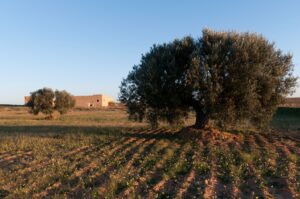
Olive trees at Domain Fendri
Over the last few years the Tunisian olive oil industry has been quietly expanding; producing larger and larger quantities of oil. And this year it looks as though production will be sufficient to qualify Tunisia for the title of second largest producer in world after Spain. Italy and Greece, normally rivals for this title, are likely to be pushed into the third and fourth places. It looks, too, as though the quality is going to be equally good. In addition, I am told that this unsung olive oil región produces 35% of the world’s organic oil.
Yet, outside of Tunisia, not a lot is known about Tunisian olive oil. In the UK, certainly, most people would be hard put to name a local producer or an olive variety. This is probably not very surprising as there are few single estate oils on sale here. The only Tunisian oil that has found its way to our shores has been in blends of various kinds with a single word reference to Tunisia hidden among the details of origin.
Tunisian oils in the UK
However, this is beginning to change. The Artisan Olive Oil Company imports Chemlali from Domaine Fendri and Chetoui from Les Moulins Majoub. These are both well established family run companies based in the regions of Sfax and Tebourba respectively. Zeet is another London based importer who brings Tunisian oils to the UK from the Keiounen región. They are currently out of stock but usually import Chemlali. Unidentified Tunisian olive oil is also stocked by Clearspings and Etsy .
A newcomer to the UK olive oil market is OLYFO. They are launching their 2500 Years of Tradition Gold and Organic Chemlali oils at the Abergavenny Food Festival later this year. They have announced that these oils are endorsed by Ann and Franco Taruschio, the legendary founders of The Walnut Tree Inn in Abergavenny.
What to expect from Tunisian oils
It is always difficult to generalise on what kind of flavour tones and degrees of bitterness and pepper to expect from a particular variety of olives. There will always be a good deal of variation depending on where the olives are grown, the timing of the harvest and the weather in a particular year. However, here is some indication of what to expect from the two main olive varieties grown in Tunisia.
Chemlali
Style: Quite smooth and gentle with little bitterness
Flavour characteristics: Light green almond and herbaceous fruitiness
Polyphenols: Low to medium
Chetoui
Style: Robust with good bitterness and pepper
Flavour characteristics: Darkly herbaceous bitter herbs and nuts
Polyphenols: Good to high